

I’ve Been Evaluated as a Teacher, a Coach, and a Principal. Here’s What I Learned From Every Seat

When I walked into my first classroom in 2003, the curriculum waiting for me in a binder lying in a file cabinet was from 1973. I am not joking.
I was a brand-new teacher in a small Wisconsin district, and that experience became the beginning of a much longer lesson in what educators need to succeed.
I spent all 19 years of my public education career in that district, starting as a social studies teacher, a role I held for over 10 years. During that time, I also coached track and field, coached and mentored teachers, and helped build our district’s mentoring program. From there, I became a dean of students, athletic administrator, high school principal, and eventually a middle/high school principal. I also completed my doctorate in Educational Leadership and Policy, earning my Superintendent’s license while learning more about that role in education.
Professional development (PD) was always part of that journey.
My master’s work focused on PD, and my dissertation explored personalized learning, and the PD teachers need to make that successful. Helping educators become the best they can be and helping them meet the needs of every student has always been where my passion lies.
Each seat taught me something different about what evaluation should be, and what it must never become.

At First, Evaluation Was Just Something I Had to Get Through
When I first became a teacher, evaluation was just a stressful experience.
My observations were announced, so I knew exactly when the principal was coming. I wanted the lesson plan to be perfect. I wanted everything to go exactly right. I would even tell my students, “The principal is coming in to observe me, so please be on your best behavior.”
Because these evaluations were pre-planned, I submitted lesson plans ahead of time. Afterward, I received feedback about what went well and what did not.
Then it was over.
Looking back, I don’t think that gave my evaluator a very realistic picture of what normally happened in my classroom.
There was not a strong connection between the evaluation, my professional development, my strengths, and the areas where I needed to grow. As a new teacher, I didn’t yet understand evaluation as a growth opportunity. I didn’t even know what questions I should be asking my principal to help me become a better teacher.
Mostly, I thought, I made it through those two days. I’m done.
I think that was what was missing for me. The evaluation happened, I got the feedback, and then we moved on. There wasn’t really a next step.
Coaching Taught Me the Importance of Clear Expectations
Being evaluated as an athletic coach looked very different.
I started as an assistant coach, and the athletic director handled evaluations. A lot of that process involved the athletic director talking with the head coach and asking how I had done that season.
I did not receive much specific feedback myself.
Later, when I became a head coach, there were better systems in place, but there still was not a clear rubric explaining exactly what coaches were being evaluated on. We did not even have a coaches’ handbook at the time. It was more of an end-of-season conversation about what went well and what did not.
When I eventually became the athletic administrator, I remembered how that felt.
So, I helped create what I wished I had been given.
We developed a coaches’ handbook. We created checklists. We made expectations clearer. Coach evaluations became part of that system.
People should know what is expected of them before they are evaluated on it. That lesson stayed with me when I moved into school leadership.
I Kept Building the Support I Needed
Looking back on my first year, teaching influenced me in yet another way.
There were only two social studies teachers in our department, and the other teacher was brand new too. I didn’t have a formal mentor, and I often didn’t know who I was supposed to ask for help.
Thankfully, I had veteran teachers who took me under their wings.
Ultimately, I became part of the team that built our district’s mentoring program. We visited other schools, attended mentoring seminars, created a mentoring handbook, and developed a more systematic process for helping new educators.
By the time I became a principal, I had learned that mentoring, evaluation, and professional development should not exist separately.
They should work together.
Because that was something I had not experienced as a new teacher, it became something I wanted to provide for others.
My Superintendent Changed How I Thought About Growth
I was fortunate to work with a superintendent who understood that evaluation was more than entering a classroom twice a year. He understood how mentoring and professional development fit into the process.
He also trusted me.
As a young administrator, I was able to lead committees, help create our mentoring handbook, develop our professional development plan, and shape what evaluation looked like at the high school.
He gave me guidance, but he also gave me enough flexibility to learn, grow, and fail sometimes.
That experience shaped the way I wanted to lead.
I wanted expectations to be clear, but I also wanted people to understand that evaluation was about helping them grow.
Those were some of the best years I experienced in education.
Our district experienced tremendous growth. Our high school received a National Blue Ribbon Award for Educational Excellence, and our district was recognized with a National Green Ribbon Award for sustainable practices. We not only had support from our school board and community, but our students bought into what we were doing.
What made me especially proud was watching our teachers grow in how they thought about individual students.
Students learn in different ways. They need to be assessed in different ways.
What I witnessed in our teachers’ innovation was just incredible to see.

Being in a Classroom Did Not Always Mean Evaluation
As a principal, I wanted to be in classrooms.
That was not always easy. There were always other responsibilities pulling me somewhere else. Principals wear many hats, especially in small districts!
When I did enter classrooms, I tried not to make every visit evaluative. Sometimes I simply sat in the back of the room and listened. I wanted teachers and students to know I was a lifelong learner, too.
I never wanted teachers to see me only as the person in power. I wanted them to see me as another member of the team who was there to support teachers and students.
That did not mean avoiding hard conversations.
Sometimes I had to tell a teacher that something needed to be improved. When I did, I often shared examples of my own failures and what I had done to correct them.
Nobody is perfect. What matters is whether we are willing to learn, make changes, and continue growing.
Feedback Needs a Next Step
Feedback has to be timely.
Whenever possible, I tried to give teachers feedback within 48 hours of an observation. Then I looked at what should happen next.
As a new teacher, I had not known what questions to ask my principal. Looking back, I realized teachers needed more time to reflect on their evaluations and think through the questions they wanted to ask me.
Good evaluation requires more than observation. It also requires:
- Trust
- Clear expectations
- Honest conversations
- Support when improvement is needed
- Space to learn and grow
- And a year-round, holistic plan for growth
If a teacher had a particular strength, maybe that teacher could lead professional development or have colleagues observe their classroom.
If someone needed support in an area, I looked for professional development or another teacher who could help.
We had a strong culture of teachers teaching teachers. Our “team” mindset made me so proud!
I remember one teacher who was incredible with the content but struggled more with organization and communication.
Instead of simply telling that person what to do, I paired the teacher with a colleague who was exceptionally strong in those areas.
It helped.
Part of that was because their strengths complemented one another. Part of it was because their personalities worked well together.
You have to know your teachers.
Sometimes another teacher is the person they are going to learn from best.
Firm but Fair
One veteran teacher I worked with early in my career showed me what that balance could look like.
She was always firm but fair. She had incredibly high expectations for students and for herself.
But the students also knew she would help them get there. She cared about them as individuals.
That combination has stayed with me to this day.
If you hold someone to high standards but still make sure they know you are there to support them, more likely than not they will rise to that standard.
That applies to students. It applies to teachers. And it applies to evaluation.
We Used to Look for a System Like This
When I came to Education Advanced, my perspective expanded beyond the one district where I had spent my career.
Now, I have the opportunity to work with districts around the country. I am able to see both how different schools operate and how many challenges are exactly the same.
When I eventually began working with Evaluation, I immediately understood what it could solve.
In my district, we had self-evaluations, goals, rubrics, professional development, and final evaluations.
But much of it was paper and pencil. The pieces existed, but they did not live together.
We wanted to be able to see the rubric, artifacts, goals, evaluation, and professional development in one place. We used to ask for a program like that.
When I saw Evaluation, it was a light-bulb moment. This is what we had been looking for.
At its best, a good evaluation system should provide:
- Clear expectations and consistent processes
- Timely, meaningful feedback
- A clear view of strengths and areas for growth
- Actionable next steps
- Individualized support for professional growth
But the system itself is not the goal.
Growth is.
Every Person Is Different
After experiencing education from all of these different roles, one lesson continues to matter most to me.
We are all individuals.
We come with different backgrounds, stories, cultures, strengths, and needs.
That is true of students, and it is true of teachers.
That belief is part of why personalized learning became such an important focus of my doctoral work.
We cannot expect every student to learn in exactly the same way.
And we should not expect every educator to grow in exactly the same way either.
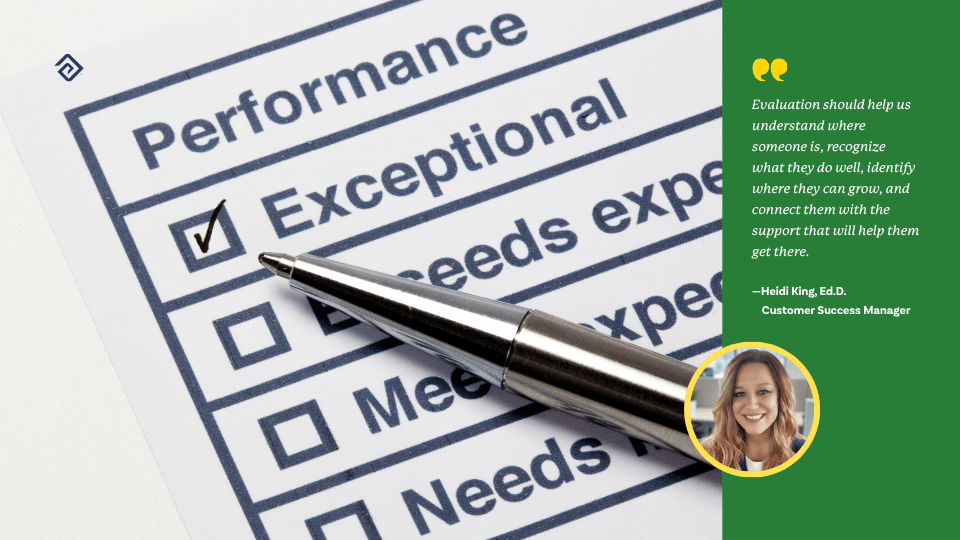
Evaluation should help us understand where someone is, recognize what they do well, identify where they can grow, and connect them with the support that will help them get there.
That is what I wish I had understood when I was the teacher nervously waiting for the principal to walk into my classroom.
It is what I tried to remember when I became the person walking through the door.

More Great Content
We know you'll love
.png)