

Efficiently document every step of the teacher evaluation process
Teacher Evaluation Software for K-12 Schools
Teacher evaluation software streamlines observations, feedback, and growth planning, helping districts ensure consistency, reduce administrative work, and turn evaluations into real development opportunities.
See How Evaluation Works
Standardize evaluation processes across campuses
Maintain clear compliance documentation
Track staff performance trends in real time
“The Evaluation Rubric is custom-made for my school. This allows me to have targeted and informed conversations to help my teachers improve in areas that will benefit our students.”
Principal, Indiana
Schedule Your Evaluation Demo
Tell us about your district and we’ll tailor the walkthrough to your evaluation process and frameworks.
What Is Teacher Evaluation Software?
Teacher evaluation software is designed to help school districts standardize, streamline, and strengthen how teacher performance is measured and supported. A modern teacher evaluation system brings together observations, rubric scoring, feedback, and reporting into one connected system. This can reduce manual work while improving visibility into educator effectiveness.
District leaders rely on teacher evaluation methods to:
Ensure consistent, fair evaluations across campuses
Align evaluations with state and district frameworks
Support ongoing professional development and coaching
Track educator growth over time using real evaluation data
Strong evaluation systems paired with actionable feedback can play a meaningful role in improving teaching practice and student learning.

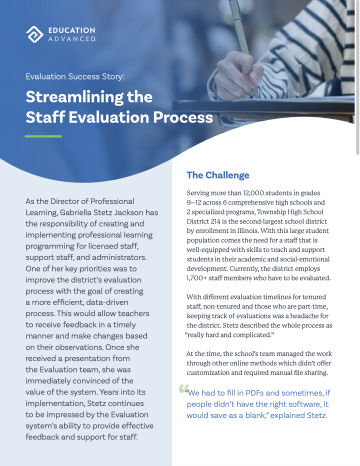
Streamlining the Staff Evaluation Process
Learn more about how Evaluation™ has helped other schools successfully support educator growth.
How Teacher Evaluation Software Works
Comprehensive teacher evaluation software supports the full evaluation lifecycle, helping districts move from fragmented processes to a clear, connected workflow:
1
Configuration and Setup
Customize your teacher evaluation system to match district goals, state requirements, and
approved rubrics. Many districts align to frameworks informed by educator effectiveness standards and research-based evaluation frameworks.
2
Classroom Observations and Evidence Collection
Conduct walk-throughs and formal observations using
digital teacher evaluation tools. Evaluators can document classroom practice, attach artifacts, and capture real-time evidence, all in one place.
3
Feedback and Coaching
Provide timely, actionable feedback tied directly to rubric criteria. Clear feedback loops are essential to supporting professional growth and improving instructional practice.
4
Performance Tracking and Reporting
Aggregate evaluation data across schools and staff to identify trends, strengths, and areas for support. Reporting helps district leaders make informed decisions about professional learning and staffing.
5
Professional Growth and Development Planning
Use evaluation insights to guide individualized development plans. Many districts connect evaluation outcomes to coaching cycles and professional learning opportunities, reinforcing continuous improvement.
See it in your district
Walk through the full evaluation lifecycle with a specialist.
Evaluation Helps Your School to:

Facilitate Educator Growth with Data
With teacher evaluation software, these insights are centralized and accessible. This can help districts turn evaluation data into clear next steps for educator growth and student success.
Provide meaningful, transparent feedback to support data-informed conversations.
Identify driving factors for educator strengths and challenges.
Develop an actionable plan based on data that can be used to improve individual performance and overall trends to measure success.
Transform Staff Evaluations with a Customized Portal
A flexible teacher evaluation system ensures your district’s unique approach to educator evaluation is fully supported, without forcing you into a one-size-fits-all model.
Build a collaborative, web-based performance portal that is tailored to meet your district’s needs for all staff evaluations.
Implement and host your own locally-created or state-approved rubric including Danielson, 5D+, Thoughtful Classroom, and McREL.
Fully customize your portal to your district’s rubrics and agreed upon metrics for all staff including administrators, classified, and non-teaching educators.


Increase Efficiency of the Staff Evaluation Process
Teacher evaluation software reduces time spent on manual tracking, enabling evaluators to focus more on meaningful feedback and less on administrative tasks.
Upload artifacts into a central repository for supporting evidence.
Provide evaluators with an easy documentation process for building walk-throughs, forms, and multiple observation types.
Give staff a single portal to record, document and gather evidence and observations throughout the evaluation process.
Introducing AI-Assisted Feedback for More Efficient Evaluations
AI-Assisted Feedback helps evaluators turn observation notes into rubric-aligned feedback, reducing time spent drafting while supporting meaningful conversations with educators.
Generate feedback suggestions based on your district’s evaluation rubric
Review, edit, and customize feedback before adding it to an evaluation
Spend less time on documentation and more time supporting educator growth
Why Teacher Evaluation Software Matters for Districts
Districts are balancing compliance requirements, educator support, and student outcomes simultaneously. Without a unified system, evaluation processes can become inconsistent, time-consuming, and difficult to scale.
Teacher evaluation software helps districts:
Standardize evaluation practices across schools
Improve transparency and trust in the evaluation process
Connect evaluation data to professional learning
Reduce administrative workload for evaluators and staff
Strengthen educator effectiveness and student achievement
Well-designed evaluation systems are critical to supporting teacher effectiveness and long-term student success.

Featured Articles
See More

Recent Blog Post

Testimonials
What Some of Our Clients Are Saying

We had around 72 indicators, but managing and evaluating them became overwhelming. State requirements were constantly changing, and it was difficult to keep up. We needed something that could handle our requirements while being more flexible and user-friendly. With the new system, we can easily manage our evaluations, and it's more intuitive for our leaders. This not only saves time but also helps us provide targeted feedback for our teachers, so they’re able to focus on improving instruction.
Director of Student Assessment & Accountability, Charter Schools USA
Had we stayed with the old system, it would have prevented us from focusing on improving teacher performance and student outcomes, which is the ultimate goal. It was amazing how easy it was. The finalization piece made it so much simpler to see everything at once. Training new administrators has become a breeze. In just an hour, they’re comfortable using the system, which used to take much longer.
Data Integration Specialist, Gratiot-Isabella Regional Education Service District, Michigan
We had to fill in PDFs and sometimes, if people didn't have the right software, it would save as a blank. People were frustrated because they would lose information and couldn't access it. When people are unhappy with a system, you've got to replace it. The fact that we now have a checklist that our staff can access takes a lot of fear out of the evaluation process and reassures them that evaluations are done for professional growth.
Director of Professional Learning, Township High School District 214, Illinois
What is Your Story?
Your Success is Our Biggest Motivator
We love hearing from our customers. Have you benefitted from one of our products? Share your story with us.
Give a Shout Out
Get Started With Evaluation Today
Get more details about how Evaluation can help your school succeed.
Request Demo

Teacher Evaluation Software FAQs
What is teacher evaluation software used for?
Teacher evaluation software is used to manage the full evaluation process, including observations, feedback, scoring, and reporting. It helps districts ensure consistency and reduce manual work.
How does teacher evaluation software support professional growth?
By providing timely, actionable feedback and tracking performance over time, educator evaluation software helps identify areas of growth and guide professional development plans.
How does a teacher evaluation system standardize observations across schools?
It uses shared rubrics, structured observation tools, and centralized data to ensure evaluations are consistent for all schools and evaluators.
Can teacher evaluation software align with state frameworks?
Yes, most systems are designed to align with state-approved rubrics and educator effectiveness standards, ensuring compliance while supporting local flexibility.
How does evaluation software improve efficiency?
It eliminates manual paperwork, centralizes documentation, and automates reporting, helping evaluators and administrators save time.
What role does data play in teacher evaluation software?
Evaluation data provides insights into educator performance, helping districts make informed decisions about coaching, staffing, and professional learning.