Building Trust in Teacher Evaluation: Lessons from the Field
Guest Post by Paul Farmer, Monroe County Community School Corporation
When people talk about teacher evaluation, the conversation usually centers around ratings.
Effective. Highly effective. Numerical scores. Rubrics. Compliance.
After 38 years in education, I can tell you with complete confidence that no evaluation score has ever made me a better educator. Not once.
What made me better were the conversations.
The honest conversations about instruction. About pedagogy. About students. About what was working and what was not. The conversations where someone sat down with me, looked me in the eye, and helped me think about how to grow.
That is what evaluation is supposed to be.
Over the years, I have served in education in several different roles. I taught biology, chemistry, and physics. I served as an administrator. I spent decades involved in our local education association, including 14 years as vice president and 9 years as president. More recently, I stepped into a role restructuring our corporation’s evaluation systems for both certified and non-certified staff across nearly 2,000 employees.
Because of that, I have sat in conversations from both sides of the table. I’ve seen what happens when teachers trust the process, and I’ve also seen what happens when evaluation feels disconnected, inconsistent, or purely about compliance. Teachers can tell the difference very quickly.
That work completely reinforced something I have believed for a long time.
Trust is the foundation of any evaluation system that actually works. If evaluation has become something people are simply trying to “get done,” the entire conversation piece disappears.

Why Trust Breaks Down
One of the biggest problems in education is that many teachers have experienced evaluation systems that felt performative instead of meaningful.
I’ve lived that myself.
At one point in my career, I went eight years without an administrator stepping into my classroom. At the end of the year, paperwork would appear showing they had supposedly completed the required visits, and I would simply sign it.
It was meaningless.
There were no conversations. No feedback. No support. No growth.
I know that when teachers experience evaluation like that year after year, trust erodes quickly.
Teachers begin assuming evaluations are simply something to “get done.” Administrators complete the forms, teachers sign them, and everyone moves on.
I call that the “get ’er done” model.
The problem is that approach does nothing to improve student learning, educator growth, or school culture.
If schools truly want evaluation systems that improve instruction, they have to create systems built around communication, consistency, and professional respect.
The Conversations Matter More Than the Score
When you really sit down and talk to teachers, most of them are asking the same thing: “How am I doing?”
They want honest feedback. They want somebody willing to have those conversations with them. They want to know somebody sees the work happening inside their classrooms.
That does not mean every conversation is easy.
As a union representative, I spent years helping educators navigate difficult situations. Sometimes there were real concerns about instruction or performance. But even in those moments, the conversation could not begin and end with criticism.
I often found myself sitting down with teachers and asking questions like:
“Are you sure this is what you want to do?”
Not because I wanted them out of education, but because sometimes people had incredible strengths that might fit a different path better. Other times, educators would reaffirm how deeply they loved students and teaching, and then you would watch them grow tremendously after receiving the right support.
That growth only happens when people feel respected enough to engage honestly in the process.
Validity Creates Buy-In
One word I come back to constantly is validity. People want evaluations that actually reflect the work they do.
That became especially obvious when we began rebuilding evaluation systems for non-certified staff in our district.
Previously, many employees were evaluated using the exact same generic questions regardless of their role. Bus drivers, custodians, maintenance staff, and other employees all received essentially identical evaluations.
Of course, professionalism and attendance matter. Those things are important.
But if you are evaluating a bus driver, shouldn’t the evaluation also reflect whether they are effective at safely transporting students? Shouldn’t the rubric actually connect to the responsibilities of the position?
The same principle applies to teachers.
Educators want evaluation systems that accurately reflect instruction, classroom environment, and student engagement. They want evaluators who understand what strong teaching looks like.
That validity builds trust because people feel seen.

Evaluation Has to Be About Pedagogy
One thing I tell administrators all the time is this:
“Evaluation is not about whether you know the content better than the teacher.”
I taught physics for many years. Administrators would sometimes tell me, “I don’t know enough about physics to evaluate your classroom.”
My response was always the same:
“I don’t care whether you know physics. It’s about the pedagogy.”
Strong instruction transcends content areas.
Whether someone teaches physics, foreign language, special education, or elementary reading, there are universal principles of effective teaching.
- Are students engaged?
- Is instruction intentional?
- Are students thinking critically?
- Is the classroom environment conducive to learning?
Those are the conversations evaluators should focus on.
When evaluation centers around pedagogy and instructional growth rather than compliance, teachers begin viewing the process differently.
Visibility Matters
One of the best principals I ever worked with used to regularly come into my classroom.
Sometimes he simply sat quietly in the back of the room. Sometimes we would talk afterward. Sometimes the conversations focused on instruction, and sometimes they focused on students.
But he was present.
That visibility mattered to me.
Teachers notice when administrators are genuinely present in classrooms. They notice when leaders take time to sit down, observe instruction, and have real conversations throughout the year instead of only showing up for formal evaluations.
Trust grows when educators believe administrators are invested in the work happening daily inside classrooms.
Over time, those small moments create culture. Teachers stop seeing evaluation as something being done to them and start seeing it as part of ongoing professional growth. That culture only develops when leaders are consistently present, approachable, and willing to have real conversations throughout the year instead of only during formal observations.
It also changes the nature of difficult conversations.
When leaders are consistently visible, feedback no longer feels random or disconnected. Teachers understand the administrator has actually seen their classroom over time, not just during a single formal observation.
That consistency builds credibility.
We Can All Get Better
One of the most important lessons I’ve learned over nearly four decades in education is that growth never stops.
Even after 38 years, I still believe I can improve. Teachers are constantly adapting because students constantly change. The way we taught before COVID is different from the way we teach now. The needs of students evolve. The world evolves. Education evolves.
That means evaluation systems cannot remain static either.
The schools that build strong evaluation cultures are the ones willing to embrace honest reflection, meaningful conversations, and shared accountability.
And honestly, that starts with being human.
Not every evaluation conversation will be easy. Some conversations are uncomfortable. Some involve difficult truths. But avoiding those conversations does not help educators or students.
What matters is creating an environment where people are not afraid to have honest conversations about instruction, pedagogy, and improvement.
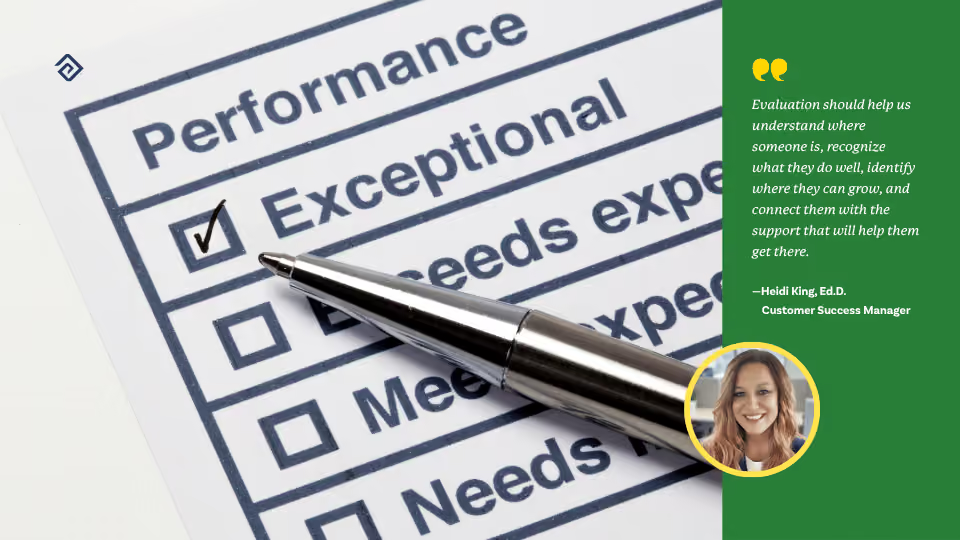
At the end of the day, evaluation should never just be about producing a score.
It should be about helping people grow.

If your school is interested in new ways to improve the learning experience for children, you may also be interested in automating tasks and streamlining processes so that your teachers have more time to teach. Education Advanced offers a large suite of tools that may be able to help. For example, three of our most popular and effective tools are:
- TestHound, our test accommodation software, helps schools coordinate thousands of students across all state and local K-12 school assessments while taking into account dozens of accommodations (reading disabilities, physical disabilities, translations, etc.) for students.
- Pathways, our college and career readiness software, helps administrators and counselors create, track, and analyze graduation pathways to ensure secondary students are on track to graduate.
- Evaluation, our teacher evaluation software, which documents every step of the staff evaluation process, including walk-throughs, self-evaluations, supporting evidence, reporting, and performance analytics.
More Great Content
We know you'll love